Grid-Down Comms: How to Protect Your Family Without Cell Towers
Cell towers fail when you need them most. Discover the three levels of grid-down communications and the essential tools you need to keep your family connected.
Most people think a cell phone is a survival tool. It isn’t.
It is a leash that relies on a fragile, multi-billion dollar infrastructure that can vanish in a heartbeat.
If the power grid fails, the cell towers follow. If a major storm hits, the network congests and crashes. If a solar flare or an EMP event occurs, your smartphone becomes a very expensive glass paperweight.
You cannot protect your family if you cannot talk to them. You cannot secure your neighborhood if you are operating in a vacuum.
At PrepperNet, we focus on the functional reality of a crisis. Hope is not a strategy. You need a communications plan that works when nothing else does.
The Vulnerability: Why Your Phone Will Fail You
The cellular network is designed for efficiency and profit, not resilience.
Cell towers usually have about 4 to 8 hours of battery backup. Some have generators, but those require fuel, and fuel stops moving when the grid goes down.
Even if the towers are powered, they will be overwhelmed. During the Boston Marathon bombing and Hurricane Katrina, the networks didn't just fail; they choked. Tens of thousands of people trying to call or text at the exact same moment will drop the system faster than a power outage.
If you are relying on a "bars" icon to keep your family safe, your plan is incomplete.
Skill Over Gear: The Preparedness Reality
Before we talk about radios, we need to talk about skill.
Most people buy a Baofeng UV-5R, throw it in a drawer, and think they are "ready." They aren't.
A radio is a tool, not a magic wand. Without knowing your frequencies, how to program your offset, or how to use a standard net script, you are just making noise.
Skill is what keeps you alive. Gear is just what you use to apply that skill.
If you have a $500 radio but don't know how to reach a local repeater, you have failed.
If you have a frequency list but have never practiced a check-in, you have failed.
The Three Levels of Communication
A real communication system is layered. You need a plan for your house, your county, and the rest of the world. We call this the PACE plan (Primary, Alternate, Contingency, and Emergency).
Level 1: Local (Family and Neighborhood)
This is for the 0 to 5-mile range. This is how you talk to your spouse when they are at the grocery store or how you coordinate with your local PrepperNet group during a neighborhood watch.
- GMRS/FRS: Great for families. FRS radios don't require a license but have limited power. GMRS requires a $35 license (no test) and allows for more power and repeaters.
- MURS: Unlicensed and often less crowded than FRS.
- Handheld Ham Radios: Highly versatile but require a Technician-level license.
Level 2: Regional (County and State)
This is the 5 to 50-mile range. When local towers are down, you need to reach out further to get intelligence on what is happening in the next town over.
- GMRS Repeaters: Many areas have community repeaters that can stay up on battery or solar.
- 2-Meter/70-Centimeter Ham Radio: The workhorse of regional comms. This is where you will find the PrepperNet PNERT teams operating.
Level 3: Long-Distance (National)
This is for when the entire region is dark. You need to know if the rest of the country is still standing.
- HF (High Frequency) Ham Radio: This allows you to bounce signals off the ionosphere and talk across the country or the world.
- AmRRON/PrepperNet National Plan: We have partnered with AmRRON to provide a standardized Signal Operating Instructions (SOI) for our members. This gives you specific frequencies and times to listen so you aren't searching through static for hours.

Tools of the Trade: What You Need Now
Don't wait for the lights to flicker to start shopping. You need to build your kit today.
- NOAA Weather Radio: Every household needs one. It’s the first line of defense for incoming environmental threats.
- Handheld Transceiver (HT): Get a Baofeng for a budget-friendly start, but move toward a Yaesu or Icom for better reliability and filtering.
- High-Capacity Batteries: Your radio is dead without power. Get extended batteries and a way to charge via 12V or solar.
- External Antenna: A handheld radio is limited by its small antenna. A "Roll-up J-Pole" or a magnetic mount antenna for your car will triple your range instantly.
The AmRRON/PrepperNet Comms Plan
PrepperNet doesn't just tell you to "get a radio." We give you a system.
By joining PrepperNet Premium, you gain access to the AmRRON/PrepperNet nationwide communications plan. This isn't just a list of frequencies; it’s a coordinated strategy.
We use standardized "Nets": scheduled times where operators check in to share intelligence (SITREPs). If you are a member, you know exactly where to tune your radio at 12:00 PM on a Tuesday to hear the latest news, even if the internet is gone.
Action Items: Your 5-Step Comms Setup
- Buy the Gear: Get at least two GMRS or Ham handheld radios and an emergency power bank.
- Get Licensed: Go to HamStudy.org and spend one weekend studying for your Technician license. It’s not as hard as you think.
- Find Your Local Group: Use the PrepperNet map to find people in your zip code who are already doing this.
- Create a PACE Plan: Write down your Primary, Alternate, Contingency, and Emergency methods for contacting your family. Print it out. Laminate it.
- Practice: Turn off your cell phones for four hours this Saturday. Try to coordinate a meeting place using only your radios. You will find your gaps very quickly.

Common Questions
Do I really need a license to talk on a radio in an emergency?
Technically, the FCC allows for unlicensed use during "immediate threats to life or property." However, if you haven't practiced before the emergency because you were afraid of the license, you won't know how to use the radio when the emergency happens. Get the license.
What is the best radio for a beginner?
The Baofeng UV-5R is the most common entry point because it’s cheap. However, if you have the budget, a GMRS radio like the Midland GXT1000VP4 is much more user-friendly for families.
Will my radio work if there is an EMP?
A radio sitting on a shelf might be fried. A radio stored in a Faraday bag or a metal ammo can with a proper seal has a much higher chance of survival. Always have spares in "cold storage."
Build Your System Before You Need It
If you are reading this, you still have time. But time is a luxury that disappears without warning.
Communication is the backbone of any survival strategy. Without it, you are isolated. With it, you are part of a community that can respond, adapt, and thrive.
Join the movement. Find your local PrepperNet group today and stop guessing about your family's safety.

Metadata Summary:
- SEO Title: Grid-Down Comms: How to Protect Your Family Without Cell Towers
- Meta Description: Learn how to build a resilient emergency communication plan using Ham radio, GMRS, and the PrepperNet/AmRRON nationwide system. Don't rely on cell phones.
- Excerpt: Cell towers fail when you need them most. Discover the three levels of grid-down communications and the essential tools you need to keep your family connected.
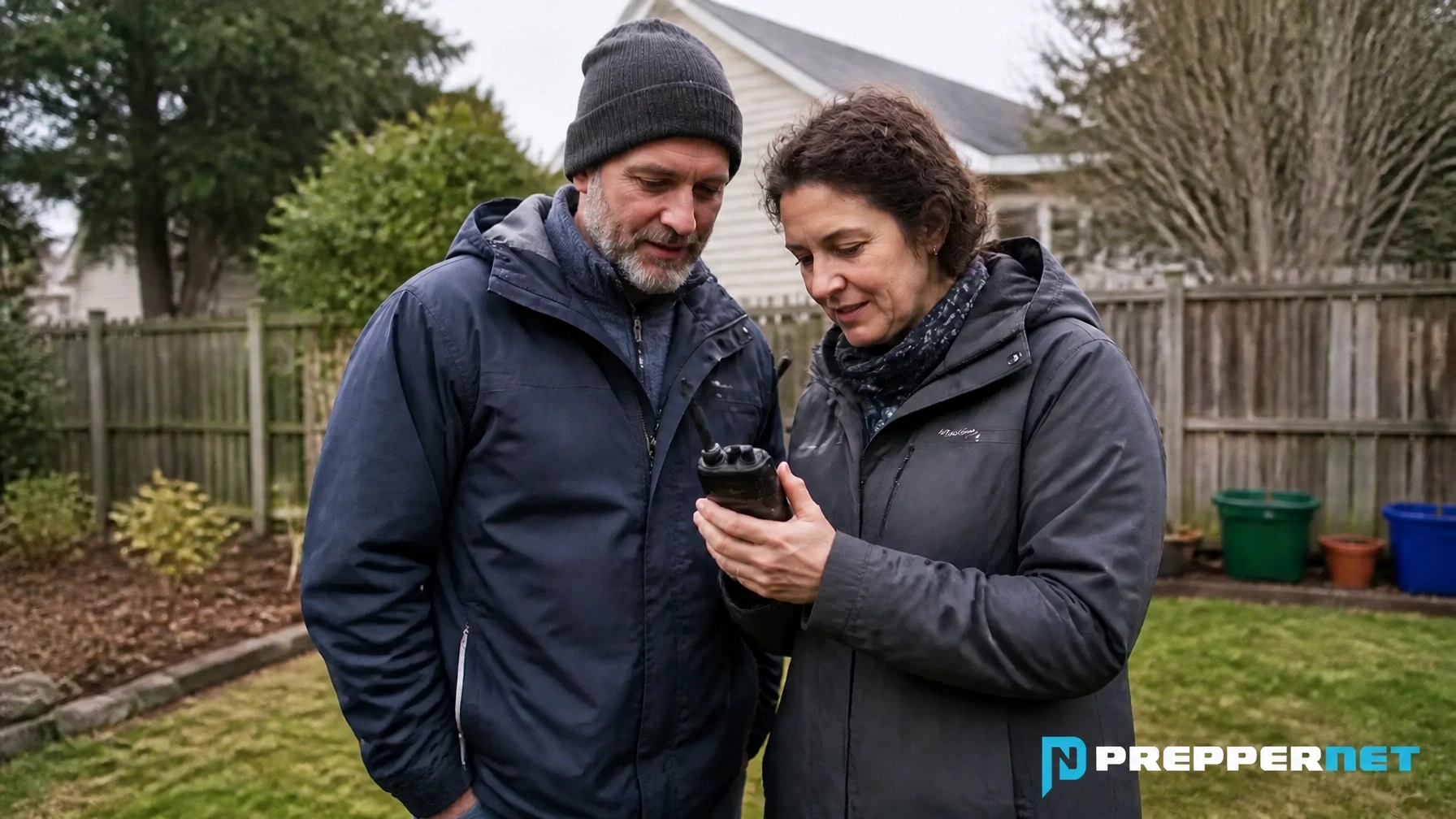
- Featured Image Alt Text: A man and woman in a backyard practicing emergency communications with a handheld radio.
- Category: Communications
- Target SEO Keywords: grid-down communications, emergency radio, Ham radio for preppers, GMRS vs FRS, PrepperNet comms plan, AmRRON SOI, Baofeng for emergencies, survival communication.
SEO Keywords
survival gear, emergency food supply, emergency preparedness, off grid living, bug out bag list, survival skills, emergency water storage, long term food storage, family preparedness plan, prepping for beginners.