The Biggest Financial Shift of Our Lifetime
This article explores my personal thesis on the yen carry trade, Japan's debt crisis, XRP, Ripple, tokenization, and the future of global liquidity. I connect ideas from James Rickards, Jake Claver, EGRAG Crypto, and others to explain why I believe the world's financial system may be entering a historic transformation.
I Think We're Watching the Biggest Financial Shift of Our Lifetime
I've been studying preparedness for over 25 years.
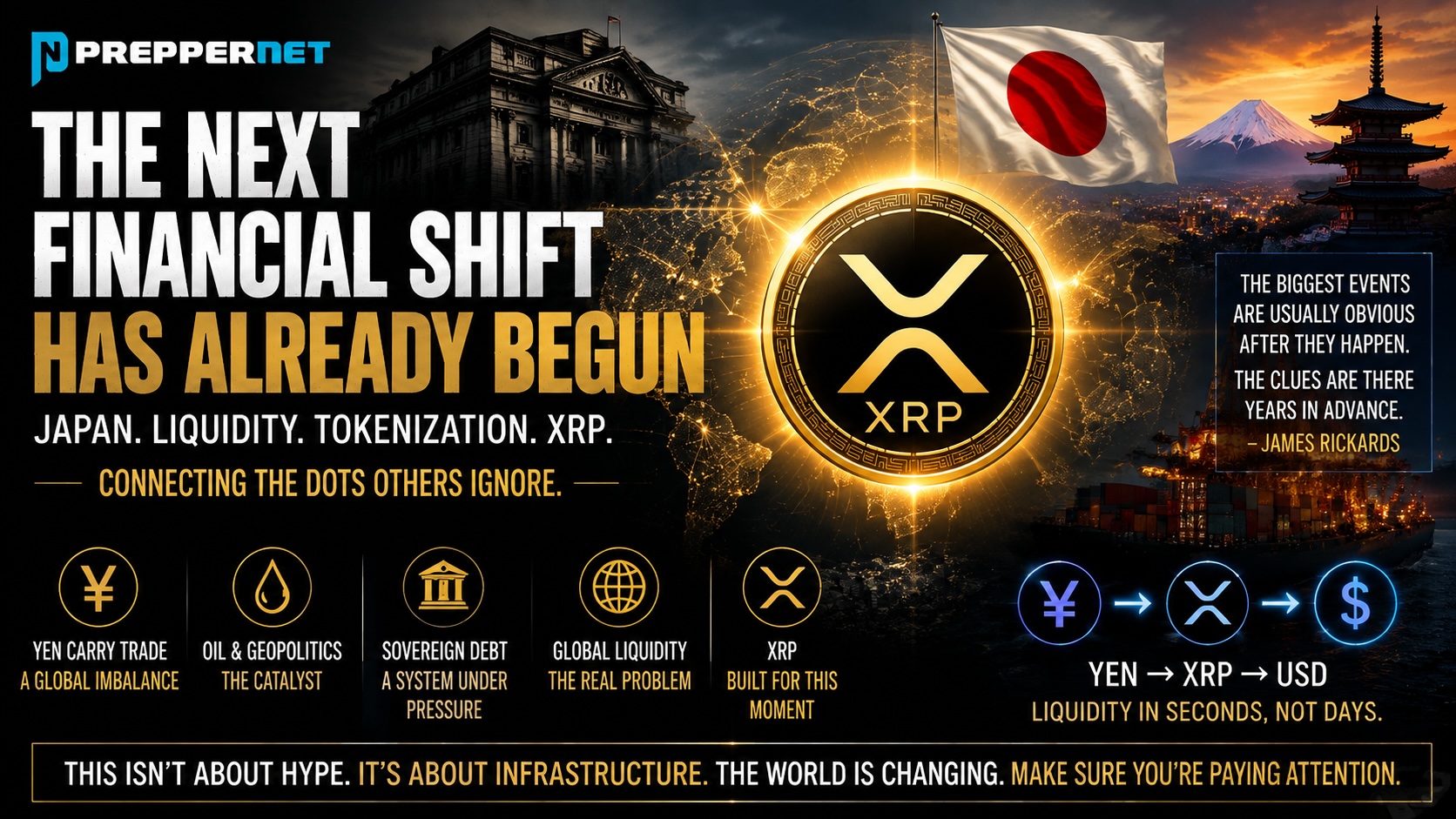
One thing preparedness teaches you is this: the biggest events are usually obvious after they happen. The clues are often there years in advance, but very few people are paying attention.
I think that's where we are today.
For the past several years, I've been listening to people like James Rickards, Jake Claver, EGRAG Crypto, and others who spend their lives studying global finance, liquidity, sovereign debt, and the changing financial system. These aren't people who all come from the same background. Some are economists. Some are investors. Some are XRP experts. Yet many of them are beginning to connect the same dots.
That got my attention.
It Starts With Japan
For decades, Japan has been the foundation of one of the largest financial trades in history—the yen carry trade.
Borrow cheap yen.
Convert it into another currency.
Buy higher-yielding assets around the world.
That strategy has helped fuel everything from stocks to bonds to real estate and even crypto.
James Rickards has been warning for years that if this trade ever begins unwinding, it could become one of the largest liquidity events the world has ever seen.
A few years ago, very few people were talking about it.
Today, it seems like everybody is.
Then Add Oil
Rickards also believes the next major geopolitical event involving Iran and the Strait of Hormuz could be the catalyst that pushes an already fragile system over the edge.
If oil spikes...
Inflation returns.
Central banks lose flexibility.
Markets lose liquidity.
Leverage begins unwinding.
One domino knocks over another.
Whether he's right or wrong isn't really the point.
The point is that his framework has remained remarkably consistent for years.
Japan's Real Problem Isn't Just Debt
The more I've studied this, the more I believe Japan's biggest challenge may not simply be its debt.
It's liquidity.
Japan has enormous wealth around the world.
The problem is that much of today's financial system requires capital to remain tied up in slow, fragmented, prefunded payment systems.
Money sits.
It waits.
It moves through multiple intermediaries.
That may have made sense twenty years ago.
I'm not convinced it makes sense anymore.
Why Ripple Chose A Different Path
This is where Ripple always stood out to me.
Years ago, most cryptocurrency projects were trying to replace banks.
Banks were the enemy.
Regulators were the enemy.
Governments were the enemy.
Ripple looked at the world completely differently.
Instead of fighting banks...
They worked with them.
Instead of avoiding regulators...
They met with them.
Instead of trying to destroy the existing financial system...
They tried to improve it.
At the time, many people criticized Ripple for taking that approach.
Today, I'm beginning to wonder if they simply saw the future differently than everyone else.
The Domino Theory
Jake Claver often talks about what he calls the Domino Theory.
I don't think he's trying to predict a price.
I think he's asking a much bigger question.
If James Rickards is even partially right...
If tokenization continues...
If financial institutions continue modernizing...
If cross-border settlement changes...
If liquidity becomes more valuable than ever...
Then what infrastructure is already built to handle that world?
That's a completely different conversation than asking whether a coin goes up next month.
Faster Money
One article that really made me stop and think came from EGRAG Crypto.
His point wasn't that XRP magically solves Japan's debt.
His point was much simpler.
Maybe the future isn't about creating more money.
Maybe it's about making existing money move dramatically faster.
That idea has stayed with me.
Money that settles in seconds instead of days.
Capital that no longer has to sit idle all over the world.
Liquidity that can be reused over and over instead of remaining trapped inside old payment systems.
That doesn't eliminate debt.
But it could make the financial system significantly more efficient.
Japan Isn't Starting From Scratch
This is another reason I keep coming back to Ripple.
Japan didn't suddenly discover Ripple last week.
Ripple has spent years building relationships in Japan through SBI Holdings and SBI Ripple Asia.
While everyone else was arguing about crypto, Ripple was building.
While everyone else was debating decentralization, Ripple was talking to banks.
That doesn't guarantee success.
But if the financial system begins changing rapidly, I'd rather already have relationships than be trying to build them from scratch.
The Bigger Picture
I've also spent time reading proposals like Maxwell Staudinger's submission to the SEC discussing XRP as a strategic financial asset, along with papers like The Great Sovereign Reset.
Whether those ideas ever become policy isn't really my focus.
What interests me is something much bigger.
People are beginning to think differently about how money moves.
How settlement works.
How liquidity works.
How sovereign debt works.
How tokenization fits into the financial system.
Those conversations simply weren't happening ten years ago.
Why I'm Paying Attention
When I invest, I'm not looking for the next hot stock or the newest cryptocurrency.
I'm looking for major trends.
Artificial intelligence is a major trend.
Energy is a major trend.
Privacy is a major trend.
I believe the modernization of the world's financial infrastructure may be another one.
When I connect the dots between the yen carry trade, sovereign debt, oil, tokenization, institutional settlement, Ripple's decade of building relationships, Japan's research into modern payment systems, and the growing discussion around liquidity, I can't help but think something much larger may be developing beneath the surface.
Maybe I'm wrong.
Maybe none of this unfolds the way I think it could.
But if even part of this thesis becomes reality over the next several years, I believe we'll look back and realize the clues were sitting right in front of us the entire time.
These are my personal opinions based on years of following this space and studying the work of people like James Rickards, Jake Claver, EGRAG Crypto, and others. Some of what I've discussed is based on publicly documented facts, while other parts are my interpretation of where current trends could lead. None of this should be taken as financial advice, and time will ultimately determine which ideas prove correct.